Loading

De-Weboo Engineering Team
IDX and MLS integration is what lets a real estate website display live, accurate property listings instead of a manually updated list. If you are evaluating real estate website development, understanding how IDX and MLS work—and how they are different—helps you scope the right build and avoid stale listings or broken feeds.
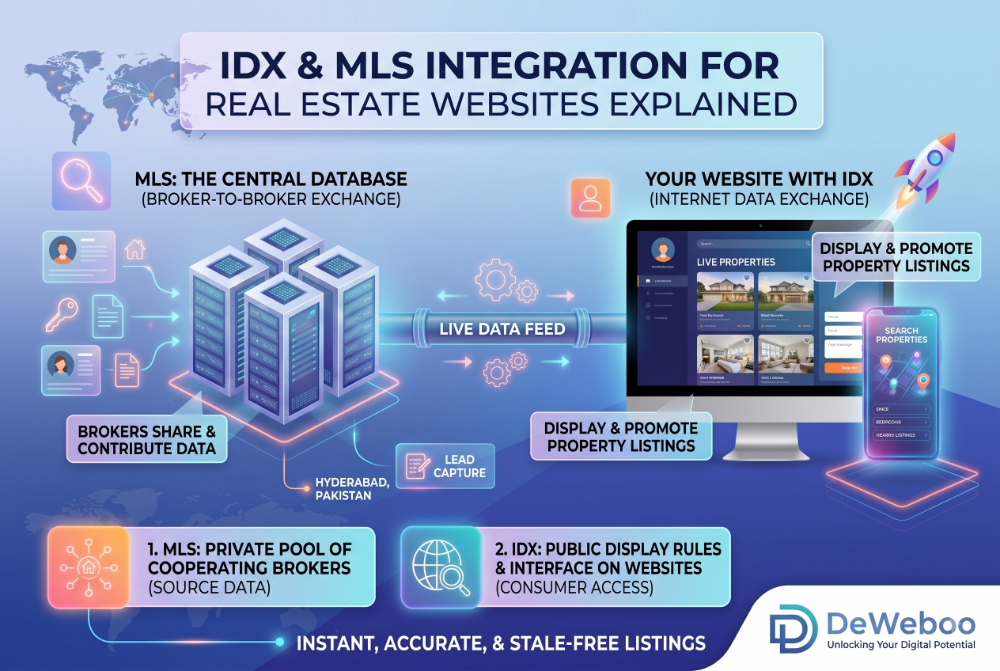
The Multiple Listing Service (MLS) is the database real estate agents and brokers use to share property listing data within a local market. It is the source of truth for listing status, price, and property details—but it is not, by itself, something the public can browse directly.
Internet Data Exchange (IDX) is the technology and set of rules that let a licensed agent or brokerage display MLS listing data on their own website. An IDX integration pulls listings from the MLS (usually through a feed provider) and renders them as searchable property pages on your real estate website, with your branding and your lead capture forms.
MLS is the shared listings database agents and brokers contribute to and pull from.
IDX is the display layer that shows those listings on a public-facing website.
You do not choose "IDX or MLS"—you need MLS access (as a licensed agent/broker) and an IDX integration to display that data on your site.
IDX feed providers (such as regional MLS-approved vendors) handle the technical sync between the MLS and your website.
Automated listing sync so new listings, price changes, and sold properties update without manual work.
Saved searches and property alerts that email or text buyers when matching listings appear.
Map-based and filter-based search built for speed, not just a data dump of listings.
SEO-friendly listing URLs and structured data, so individual property pages can rank in search.
Lead capture tied to specific listings, routed to the right agent automatically.
The most common issues we see: choosing an IDX provider that is not approved for the local MLS, slow listing pages that hurt both SEO and conversion, and lead forms that capture inquiries but never route them to an agent. De-Weboo scopes IDX/MLS integration as part of real estate website development so the feed, the search experience, and the lead routing are built together—not bolted on after launch.
Request a consultation on Real Estate Website Development—commercial projects or healthcare IT briefings.
Contact De-Weboo